

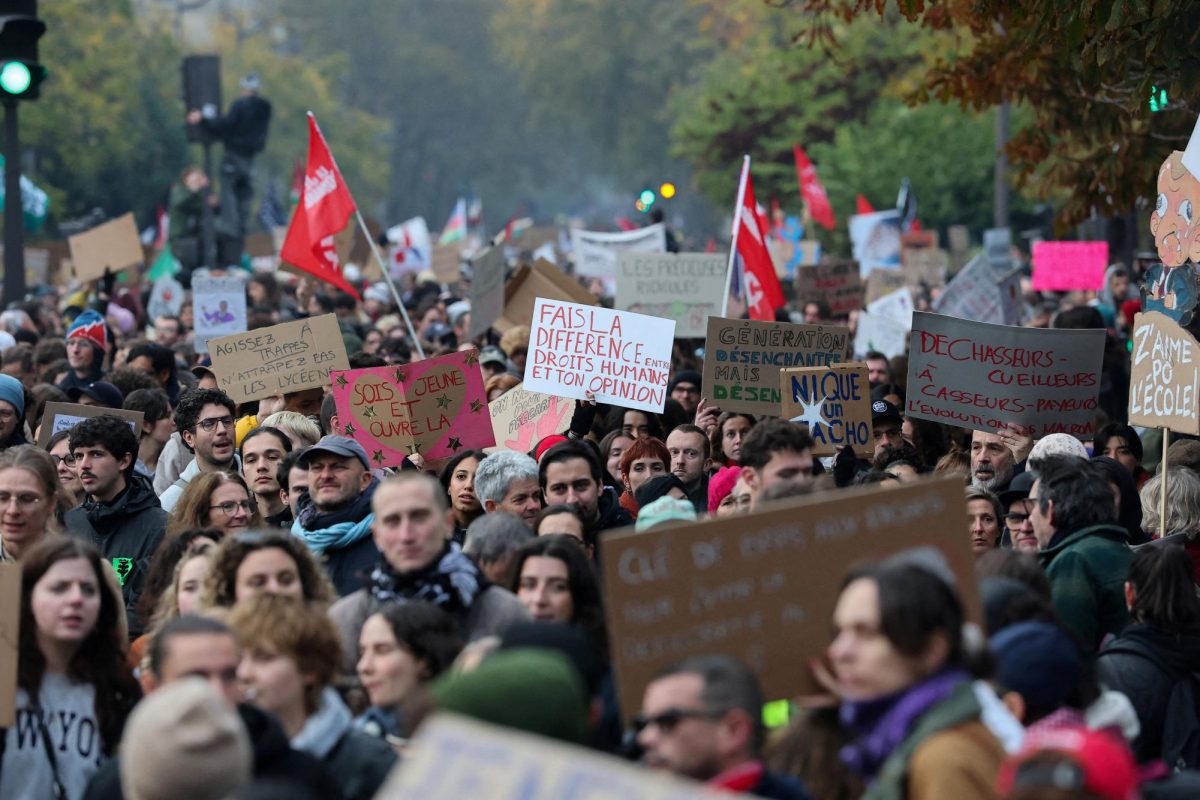



























Over the past few months, France has undergone a period of significant unrest due to cuts to school funding and social programs. These protests have now become increasingly widespread in the country and already caused massive property damage, such as the town hall of Limoges, which protesters burned to the ground. Furthermore, as per Euronews, at least 3,000 French shops have been hit by protesters.
The massive damage, though a direct result of the protesters, can be argued to spring from the recent cuts to social welfare and school funding, an attempt by Macron’s government to alleviate France’s large debt, and from increases in the cost of living due to the US and Israel’s war against Iran.
The protests have had a significant effect on daily life for people in France and particularly Paris, the epicenter of the protests. The author’s cousin Philippine, who lives in Paris, remarked that “The protests spread across the city, so many neighborhoods were inaccessible for several weekends in a row.”. She also noted how unusual it was that protests had occurred outside of Paris, and that there was a general fear that the violence would return, and so “Nobody dared to organize outings or plan to go downtown, and some people even chose to leave the city for the weekend.”
While she – like most Parisians – did not participate she said that she knew that some of her friends, specifically doctors, and those employed by the state did go out and protest, as they were among the hardest hit by the austerity, which directly affected their workplaces and pay. This is part of the reason that the protests have become very widespread, that a large percentage of the French workforce is directly employed by the government, roughly 20%, as per Statista, and so are directly affected by the welfare cuts.
Many Parisians, like Philippine agree with the cause and what they are trying to fight for, but the majority, like her, disagree with the violent form which the protests have taken on, remarking that in her view “violence has never led to significant progress.”
While the protests are to an extent justified, there is something to be said for government austerity. France seems to be on the cusp of a sovereign debt crisis, with debt being 120% of their GDP, which is especially bad for France given that as a Eurozone country, they can only control their fiscal policy, not their monetary policy, meaning that currency manipulation is out of the question for them, and so they must solve their woes by tightening their spending, which has sunk them into the debt in the first place. Among developed countries, France spends more than any other on welfare, as a % of GDP, at around 33% of GDP. Combined with Military and Infrastructure spending, France has been spending more than it makes for years, and due to popular support for the welfare state, has been unable to stop doing so. Today both the right winger Le Pen and left winger Mélenchon advocate for an even stronger welfare system. As such, it seems that France finds itself between the rock of protests, and popular disapproval of austerity, and the hard place of defaulting on its debt.